- pantouwater
- 0 Comments
- 15 Views
Water infrastructure is something most of us rarely think about.
We turn on a tap and expect clean water to be there. Behind that simple action is usually an extensive network of reservoirs, wells, treatment facilities, pumps, pipelines, and storage systems.
But what happens when the local source can no longer provide enough water?
In some communities, the answer is surprisingly physical:
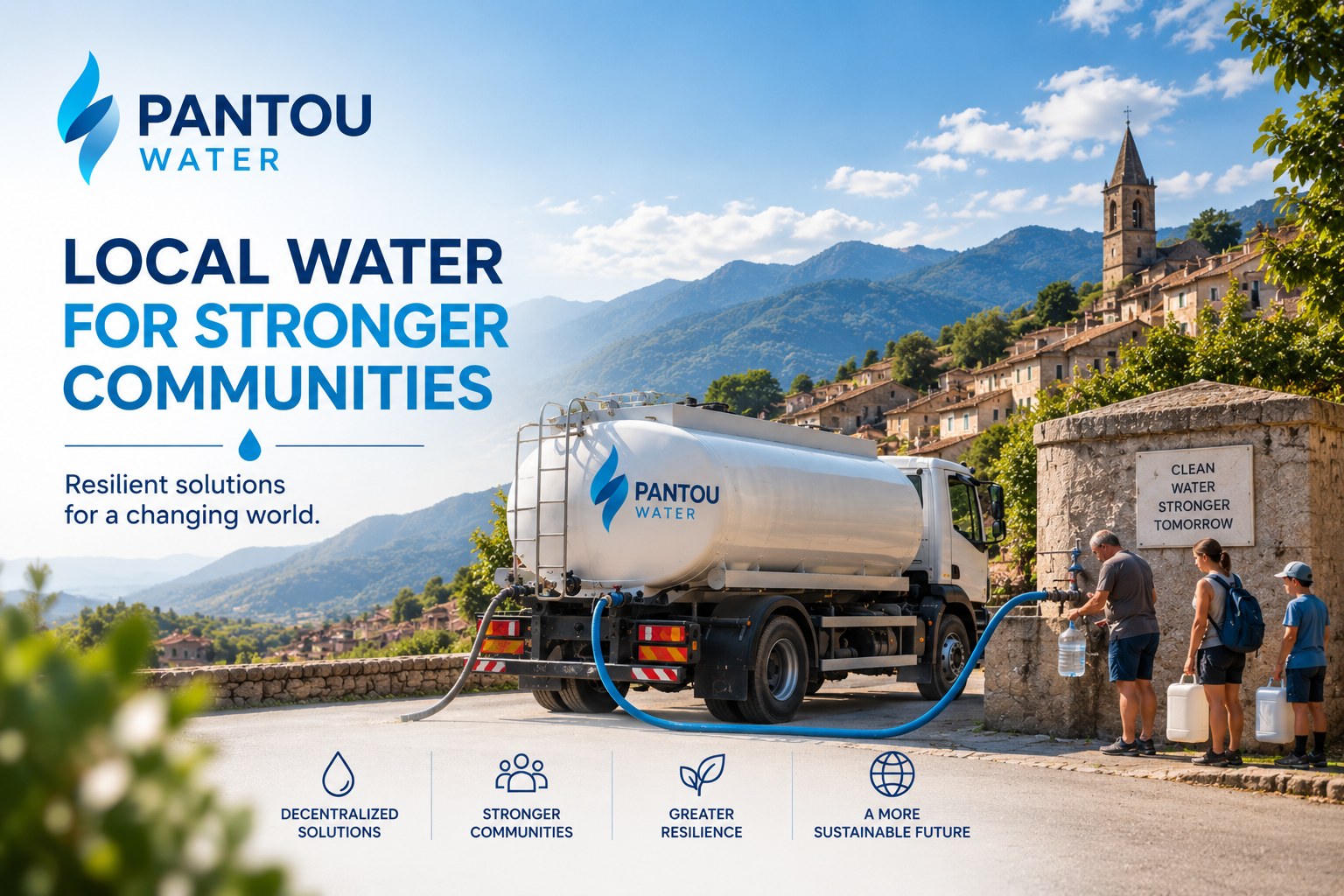
Drinking water arrives by truck.
Recent drought conditions in parts of Europe have provided a striking example. In Sainte-Marie-aux-Mines in eastern France, prolonged heat and reduced flows from the mountain springs supplying the community reportedly led to tanker trucks being used to deliver drinking water.
For residents, trucks effectively became a temporary water pipeline on wheels.
It is an emergency response that can keep communities functioning. But it also raises a much bigger question about the future of water infrastructure:
What if more of our water could be produced where it is actually needed?
When a Reliable Water Source Stops Being Reliable
Many towns and smaller communities depend heavily on a limited number of local water sources.
These might include mountain springs, groundwater wells, rivers, reservoirs, or seasonal snowmelt.
Under normal conditions, these systems may operate reliably for decades.
Climate variability changes that assumption.
Extended heat, declining precipitation, changing snowpack, and prolonged drought can reduce the amount of water available from sources that communities once considered dependable.
The problem is not necessarily that the water source disappears completely.
Sometimes its flow simply falls below the level required to meet local demand.
At that point, a community must either reduce consumption, find another source, or bring water in from somewhere else.
Water by Truck Works, but at a Cost
Tanker trucks play an essential role during water emergencies.
They can move large volumes relatively quickly and provide a temporary supply while authorities respond to drought, contamination, infrastructure failure, or other disruptions.
But transporting water by road is fundamentally different from having a reliable local supply.
Every delivery requires a source of water somewhere else, a tanker, a driver, fuel, road access, coordination, storage, and repeated trips.
The farther the water must travel, the more complicated the logistics become.
For isolated communities, emergency camps, remote facilities, islands, and rural settlements, these challenges can become even more significant.
There is also an important resilience issue.
If a community depends on trucks during an emergency, its water supply becomes linked to transportation infrastructure. Road closures, severe weather, fuel shortages, equipment problems, or competing emergency demands can all affect deliveries.
Tanker water is therefore an important emergency tool—but it is difficult to view continuous trucking as an ideal long-term water strategy.
Water Scarcity Is No Longer Only a Desert Problem
Water scarcity is often associated with extremely dry regions.
That picture is becoming outdated.
Communities in relatively temperate and historically water-secure regions are increasingly experiencing drought, seasonal shortages, restrictions, declining groundwater levels, or pressure on existing infrastructure.
The issue is not simply how much water exists across an entire country.
What matters locally is whether sufficient clean water is available at the right place, at the right time, and in a form that can be safely used.
A region can contain significant freshwater resources while individual communities still experience shortages.
That distinction is becoming increasingly important as climate conditions become less predictable.
Centralized Infrastructure Remains Essential
The solution is not to abandon traditional water infrastructure.
Municipal treatment plants, reservoirs, wells, pipelines, and distribution networks will remain the foundation of water supply for cities and communities.
But relying on a single source can create vulnerability.
Modern infrastructure resilience increasingly depends on redundancy.
Electricity systems use backup generators and battery storage. Data infrastructure uses redundant servers and network connections. Critical facilities maintain emergency systems precisely because primary infrastructure can occasionally fail.
Water deserves the same thinking.
Rather than asking whether decentralized systems should replace centralized infrastructure, a better question is:
Can they provide another layer of protection when conventional supplies are under pressure?
Producing Water Closer to Where It Is Needed
One emerging approach is decentralized water production.
Instead of transporting all water from a distant source, some portion of demand can potentially be produced, recovered, treated, or stored locally.
Depending on location and application, decentralized solutions can include rainwater harvesting, local purification, water recycling, mobile treatment systems, desalination, and atmospheric water generation.
Each technology has different strengths and limitations.
The important principle is diversification.
A community with several possible water sources is generally more resilient than one entirely dependent on a single spring, reservoir, pipeline, or delivery route.
Atmospheric Water Generation Offers Another Possibility
Atmospheric Water Generation, or AWG, takes advantage of a resource that surrounds us almost everywhere: moisture in the atmosphere.
AWG technology captures water vapour from ambient air and converts it into liquid water, which can then undergo appropriate treatment before use.
Unlike conventional water infrastructure, atmospheric water generation does not require a direct connection to a river, lake, groundwater well, or municipal pipeline.
This creates interesting possibilities for decentralized applications.
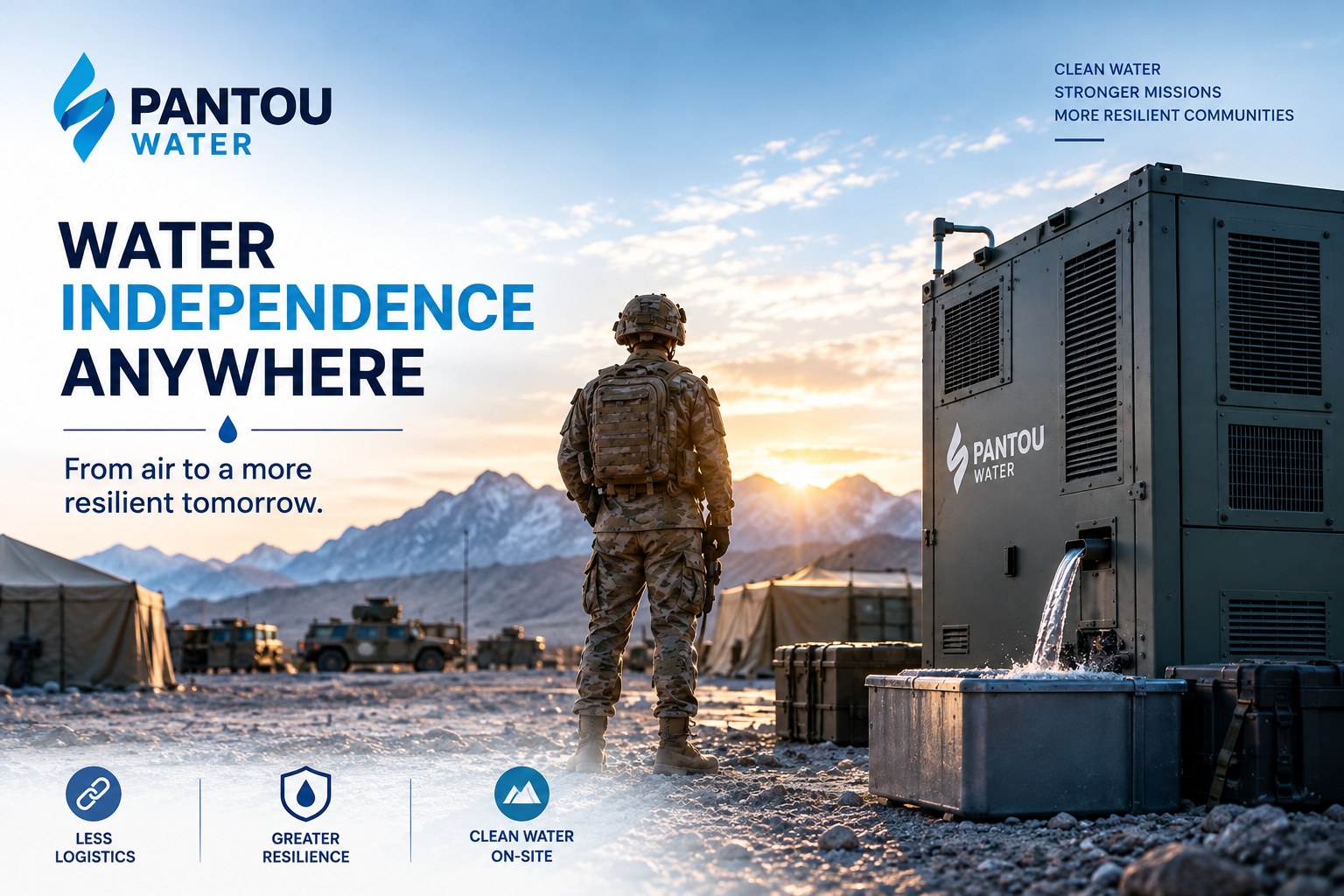
Potential use cases include remote communities, emergency-response locations, off-grid facilities, tourism sites, temporary camps, homes, and locations where conventional water supplies are disrupted or difficult to expand.
At Pantou Water, we are developing an adsorption-based atmospheric water generation platform intended to capture moisture from air and produce clean water locally, with particular attention to operation under challenging humidity conditions.
The objective is not to suggest that atmospheric water generation can replace municipal water systems.
It is to create another available source.
Why Local Water Production Matters During Drought
Imagine two communities facing the same decline in their primary water source.
The first depends entirely on that source. When supply falls below demand, almost every additional litre must be transported from elsewhere.
The second also has local storage, conservation measures, water reuse, and decentralized water-generation capacity.
Neither community is immune to drought.
But the second has more options.
Even if decentralized systems provide only part of total demand, they may reduce the amount of emergency water that must be transported and provide additional capacity for critical applications.
Hospitals, community centres, emergency shelters, schools, and other essential facilities could potentially benefit from having independent water-production capability.
This is what resilience means in practice: not eliminating every risk, but reducing dependence on any single point of failure.
The Energy-Water Connection Matters
Producing water locally is not automatically sustainable.
Every water technology requires resources.
Atmospheric water generation requires energy. Desalination requires energy. Pumping groundwater requires energy. Municipal treatment and distribution require energy. Transporting water by truck consumes fuel.
The relevant question is therefore not whether a technology uses energy, but how efficiently water can be produced and delivered under specific conditions.
For decentralized technologies, integration with renewable energy can be particularly important.
Solar-powered or hybrid systems could potentially enable water production in locations where both water and electrical infrastructure are limited.
Future water planning will increasingly need to consider energy and water as interconnected systems rather than separate infrastructure categories.
A New Definition of Water Security
Water security is sometimes reduced to a simple question:
Is there enough water?
A more useful definition asks whether safe water remains accessible when conditions change.
A resilient system should be able to withstand drought, contamination, infrastructure failures, extreme weather, and unexpected increases in demand.
That requires more than capacity.
It requires flexibility.
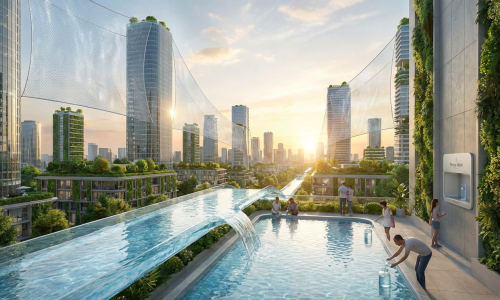
The future water system may therefore look less like a single pipeline and more like a portfolio of complementary resources: centralized supply, recycling, storage, conservation, rainwater capture, alternative sources, and decentralized generation.
From Emergency Response to Long-Term Resilience
Seeing tanker trucks deliver drinking water to a town should not simply be viewed as an unusual response to an unusually dry year.
It should prompt a broader conversation.
How vulnerable is our community if its primary water source declines?
How quickly could an alternative supply be established?
How much emergency water would need to be transported?
Which critical facilities need independent backup?
And which technologies could reduce dependence on transported water?
These are questions worth answering before a shortage occurs.
The Future of Water May Be More Local Than We Think
For more than a century, modern water infrastructure has largely been built around moving water: from reservoirs to cities, from treatment plants through pipelines, and during emergencies, from one region to another by truck.
That model will remain essential.
But the next generation of water infrastructure may increasingly add another capability:
producing water where people actually need it.
Atmospheric water generation is one part of that emerging landscape.
At Pantou Water, our focus is on developing decentralized technology that can complement existing water systems and provide another layer of resilience when traditional supplies are limited, disrupted, or difficult to access.
Because when trucks become the pipeline, the challenge is no longer simply finding more water.
It is building a water system with more options.
About Pantou Water
Pantou Water is developing next-generation atmospheric water generation technology designed to capture moisture from the air and convert it into clean water through a decentralized system. Our vision is to support greater water independence and resilience across applications including off-grid users, remote communities, emergency response, hospitality, and infrastructure-constrained locations.
Pantou Water — Clean Water. Independent. Sustainable. Secure.