- pantouwater
- 0 Comments
- 189 Views
For many RV travellers, freedom is the whole point of the journey. You choose the road, the destination, and how long you want to stay. But even with solar panels, batteries, mobile internet, and modern off-grid equipment, one basic resource can still determine where you can go and how long you can remain there: water.
Fresh water is heavy, storage space inside an RV is limited, and reliable refill points are not always available near remote campsites. For travellers who enjoy boondocking, dispersed camping, or exploring areas far from established infrastructure, water can quickly become one of the biggest constraints on an otherwise independent lifestyle.
What if an RV could produce part of its water supply directly from the air around it?
That is the idea behind atmospheric water generation and the technology Pantou Water is developing.
Water Is Still One of the Biggest Limits of Off-Grid RV Travel
Modern RVs have become remarkably capable off-grid platforms. Solar systems can generate electricity during the day. Lithium batteries can store enough energy to operate appliances overnight. Satellite connectivity can keep travellers online hundreds of kilometres from a city.
Water is different.
An RV has to carry it, find it, or receive it from somewhere.
For a longer trip, that can mean planning routes around potable-water stations, carrying additional containers, driving into town simply to refill a tank, or purchasing bottled water along the way.
And water is heavy. One litre weighs approximately one kilogram. Carrying an additional 50 litres means adding roughly 50 kilograms before considering the containers themselves.
For people trying to travel lighter and stay off-grid longer, simply carrying more water is not always the best solution.
What Is an RV Water Generator?
An RV water generator based on atmospheric water generation takes a fundamentally different approach.
Instead of relying exclusively on stored water, the system captures moisture that is already present in the surrounding air and converts it into usable water.
Air contains water vapour even when it does not feel particularly humid. Atmospheric water generation technologies are designed to capture that moisture, convert it into liquid water, and then treat the collected water before use.
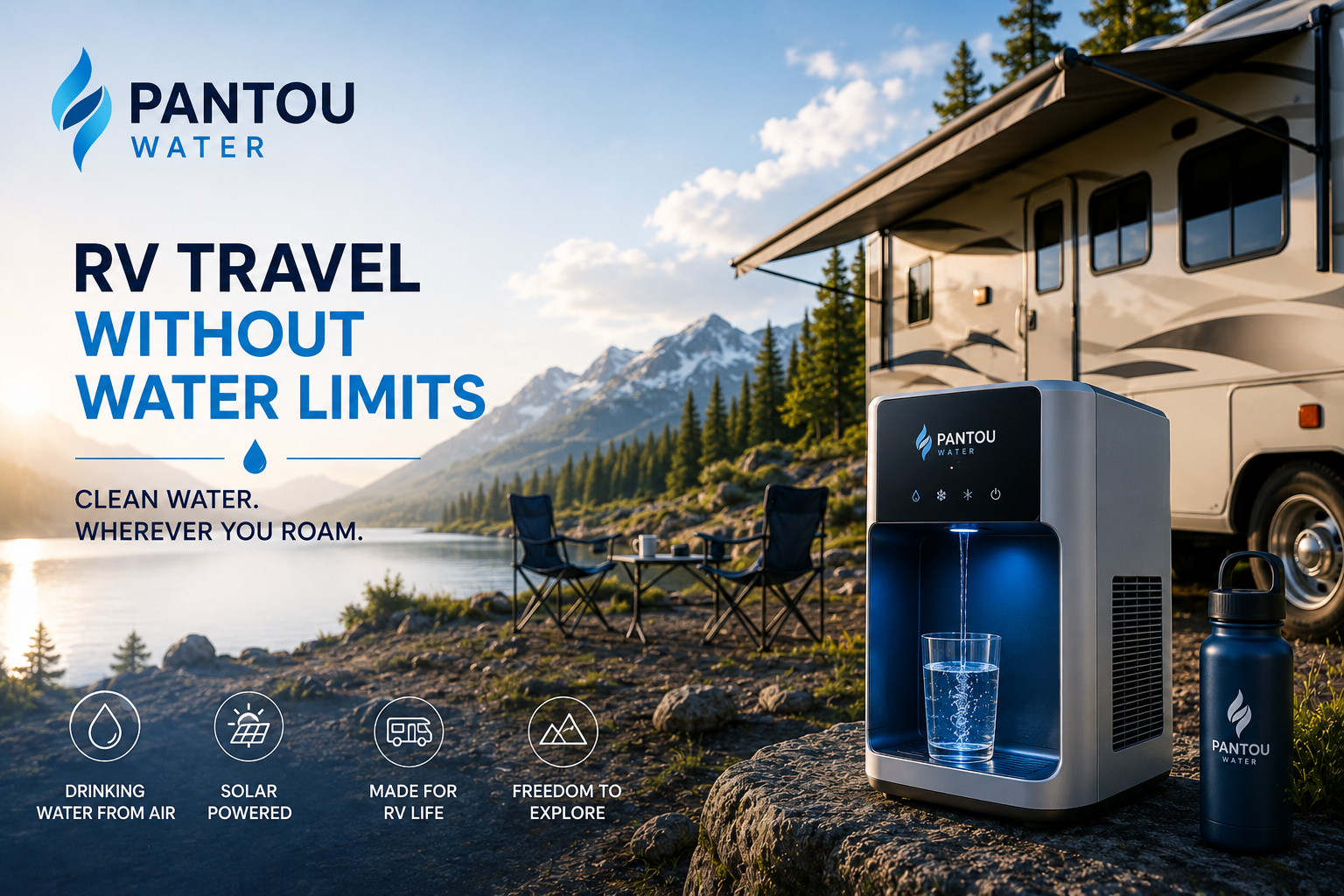
Pantou Water is developing a portable Atmospheric Water Generator (AWG) specifically with outdoor, mobile, and off-grid applications in mind. The system uses an adsorption-based approach to capture moisture from the air before the collected water moves through treatment stages including filtration, UV-C disinfection, and mineral enhancement.
The goal is simple: produce clean drinking water closer to where it is actually needed.
Why Conventional Water Solutions Can Be Difficult for RV Travellers
Most RV owners already use a combination of freshwater tanks, campground hookups, portable containers, filtration systems, and bottled drinking water.
These solutions work, but they all depend on having access to a water source in the first place.
For weekend camping near established campgrounds, that may not be a significant problem. For extended off-grid travel, however, the situation changes.
Imagine finding a quiet campsite beside a mountain, desert trail, or remote lake. Your solar system has enough capacity. Your batteries are charged. You have food and connectivity.
But your freshwater tank is running low.
Suddenly, the length of your stay is determined not by your schedule, but by the nearest reliable water source.
This is where new camping water solutions can make a meaningful difference.
From Carrying Water to Producing Water
Atmospheric water generation introduces a different model for outdoor water access.
Instead of asking:
“How much water can we carry?”
travellers can increasingly ask:
“How much of our daily water demand can we produce where we are?”
That distinction matters.
An atmospheric water generator does not necessarily need to replace every source of water inside an RV. Water consumption varies significantly between travellers, climates, seasons, and activities.
Instead, it can become another component of an off-grid water strategy alongside storage tanks, responsible water use, filtration, and planned refilling.
For drinking and other appropriate uses, locally generated water could reduce the frequency with which travellers need to leave a campsite solely to replenish their supply.
Designed for Low-Humidity Conditions
Humidity is one of the major technical challenges facing atmospheric water generation.
Many conventional AWGs rely primarily on cooling and condensation. Their performance can decline substantially as environmental conditions become cooler or drier.
That matters for RV users because outdoor travel rarely happens under one ideal climate.
A trip might move from the humid Pacific coast to the Canadian interior, through mountain environments, or into significantly drier regions.
Pantou Water is therefore developing its technology around an adsorption-based water-harvesting process, with the system being designed for operation in low-humidity environments. The current development targets conditions in approximately the 10–30% relative-humidity range, although actual water production will depend on environmental and operating conditions.
This approach is particularly relevant to outdoor applications because a practical RV water generator needs to function across more than just warm, humid destinations.
How Pantou Water Works
The process begins with ambient air entering the device.
An adsorbent material captures moisture from that air. The captured water vapour is subsequently released through a controlled process and converted into liquid water.
From there, the water passes through the system’s treatment process, including multi-stage filtration, UV-C disinfection, and mineral enhancement before delivery to the user.
Pantou’s current platform is being developed with water production of up to 64 litres per day, depending on operating and environmental conditions. It is also being designed for compatibility with grid and solar-powered applications.
For RV and outdoor users, that combination of decentralized water production and renewable-energy compatibility is particularly important.
Water and Energy Independence Belong Together
The off-grid RV movement has already transformed how travellers think about electricity.
Years ago, staying away from a powered campground often meant running a generator or carefully conserving a small battery bank. Today, rooftop solar, lithium batteries, efficient appliances, and advanced power-management systems have made energy independence increasingly practical.
Water could follow a similar path.
An RV equipped with renewable power and atmospheric water generation could potentially become less dependent on both electrical hookups and frequent water stops.
That does not mean unlimited resources. Atmospheric conditions, available energy, system capacity, maintenance, and daily consumption will always matter.
But it changes the equation.
The objective is not to promise “infinite water.” It is to make water independence more practical.
Fewer Plastic Bottles on the Road
Bottled water remains a common backup for campers, particularly when there is uncertainty about the quality of a local source.
But cases of bottled water occupy valuable storage space, add weight to the vehicle, generate plastic waste, and have to be purchased repeatedly.
Producing water closer to the point of use offers another possibility.
For frequent travellers, reducing dependence on single-use bottled water can mean less storage, fewer shopping stops, and less plastic waste generated during each trip.
That fits naturally with a broader shift already taking place in outdoor travel toward solar energy, reusable equipment, lower-impact campsites, and more sustainable resource use.
A New Category of Off-Grid Camping Water Solutions
The future of RV travel will likely involve increasingly self-sufficient vehicles.
Power is already moving in that direction. Connectivity has followed. Water is one of the next major challenges.
Pantou Water is initially focusing on outdoor and RV users as a primary market for its technology, alongside recreational boaters, outdoor enthusiasts, eco-lodges, and outdoor rental operators.
Over time, the same decentralized approach could also support remote communities, tourist facilities, industrial camps, emergency-response operations, and other locations where transporting clean water is difficult or expensive.
For RV travellers, however, the value proposition is especially intuitive.
Carry less. Stay longer. Depend less on infrastructure.
The Road Ahead
True off-grid travel is not about disconnecting from everything. It is about having the tools to operate independently when conventional infrastructure is unavailable.
Atmospheric water generation has the potential to become one of those tools.
Pantou Water is currently progressing through prototype development, Canadian testing, validation, and pilot preparation rather than presenting the technology as a fully commercialized product today.
The vision is to make clean-water access more decentralized and practical for people who deliberately travel beyond traditional infrastructure.
Because the freedom of RV travel should be defined by where you want to go — not where the next water tap happens to be.
Pantou Water — Fresh water, anytime, anywhere.